Saturday, September 15, 2012

Two by Ed Yong

Ed Yong always brings even simple stories alive with an interesting twist, an analogy, or just good writing. Here are links to two of his stories from late this week ... with a taste of each.


Ed Yong, Why type 2 diabetes is a bit like The Bourne Identity
Why type 2 diabetes is a bit like The Bourne Identity
In The Bourne Identity, the eponymous hero is presumed dead by his former employers, but turns out to have merely lost his memory. Thus unburdened, he attempts to change his fate.

Which reminds me of diabetes.

People with type 2 diabetes face two problems, both related to insulin – the hormone that regulates the levels of sugar in our blood. They don't respond properly to it (they become insulin resistant), and they don't make enough of it. As a result, the levels of sugar in their blood become too high. Insulin resistance is fairly steady throughout a person's lifetime, but the failure to make insulin gets progressively worse. The typical explanation is that the beta-cells – a type of insulin-making cells within the pancreas – die off.

But Domenico Accili from Columbia University has a different idea. By studying diabetic mice, he has found beta-cells do indeed disappear over time, but not because they die. Instead, they revert back to a more basic type of cell that doesn't produce insulin. Like Jason Bourne, they lose their former specialised identities and become more of a tabula rasa. In the film, it's simple memory ...

                                  ____________________________

Ed Yong, Why do killer whales go through menopause?

Here's yet another reason why humans are weird: menopause. During our 40s, women permanently lose the ability to have children, but continue to live for decades. In doing this, we are virtually alone in the animal kingdom. From a cold evolutionary point of view, why would an animal continue to live past the point when it could pass on its genes to the next generation? Or put it another way: why don't we keep on making babies till we die? Why does our reproductive lifespan cut out early?

One of the most popular explanations, first proposed in the 1966, involves helpful grandmothers. Even if older women are infertile, they can still ensure that their genes cascade through future generations by caring for their children, and helping to raise their grandchildren.* There's evidence to support this "grandmother hypothesis" in humans: It seems that mothers can indeed boost their number of grandchildren by stepping out of the reproductive rat-race as soon as their daughters join it, becoming helpers rather than competitors.

Now, Emma Foster from the University of Exeter has found similar evidence among one of the only other animals that ...


Three by Krulwich

There's something so gentle and generous about Robert Krulwich's pieces. Not always packed with information, but provocative little hints about different ways of looking at the world. Here are three of his pieces from this week ... with just a taste of each. Follow the links to the full stories.

Robert Krulwich, The Miracle Of The Levitating Slinky

[Rusten: Top of the story follows. Several embedded videos in the piece.]

I should say right off, this is no miracle. The Slinky I'm going to show you does what all Slinkys do, even if it seems so astonishing, you figure, "Oh, come on. Somebody doctored this footage. This can't be."
It can be. It is. Nobody manipulated anything.
Here's what's going to happen. Derek Muller from the Australian science video website Veritasium is going to take a slinky and hold it from the top with his hand. He will then release the lower part. It will slink down to its full extension, elongating, and come to a dangling rest.
Then Derek is going to let the Slinky go. Now comes the miracle. If you keep your eye on the bottom of the slinky, on the last curl at the very end, you will notice that as the top of the slinky starts to fall, the bottom doesn't drop. It just hangs in the air, levitating, as if it had its own magic carpet. It will stay there, hovering quietly, until a wave, or signal, passing through the slinky finally reaches it. Apparently, the bottom doesn't know it's supposed to fall, so it sits there, seeming to defy gravity, until the very end ...

                            _______________________

Robert Krulwich, That Old Rice-Grains-On-The-Chessboard Con, With a New Twist

[Rusten: Top of the story follows. This piece has several Krulwich drawings.]

Once upon a time, says the science writer David Blatner, there was this con man who made chessboards for high-end clients — in this case, a king.
The craftsman was good; his chessboards were better than beautiful. The king, he knew, loved chess. So he hatched a plan to trick the king into handing over an enormous fortune. His plan? He figured, "This king is not too good at math."
So when the craftsman presented his chessboard at court, he told the king,
"Your Highness, I don't want money for this. Or jewels. All I want is a little rice."
"Hmm," thought the king, who was a con man himself. "I've got rice. How much rice?" ...
                                                 _______________________________

Robert Krulwich, Odd Things Happen When You Chop Up Cities and Stack Them Sideway

[Rusten: Instead of giving you the top of this story, I'll just give you two images of Berlin: an overhead depiction of the size and shapes of building plots, and those same plots arranged "after an autopsy. The city has been dismembered, dissected block by block, the blocks then categorized, sorted and stacked by shape". Krulwich compares these with similar images of other major cities, like Paris, New York, and Istanbul ... with his usual, interesting take on the project that produced these. All of the images in the piece are larger, of course.]

     
Berlin from above.                           Berlin in parts.

Thursday, September 13, 2012

Ancient cliff-clinging flower and three species of ant

A lovely story from Ed Yong of multiple mutualisms involving a very rare, cliff-clinging plant that may live 300 years or more and three species of ants: "Ancient flower lives only on two Spanish cliffs, and uses ants to survive"

Top of the story:

This story begins with a cliff-hanger. On the Spanish side of the Pyrenees mountains, around 850 metres above sea level, two adjacent cliff faces hold the entire population of Borderea chouardiione of the world's rarest plants. It's a small herb that grows into crevices in the rock. Its leaves are heart-shaped and its flowers green and unassuming. There are around 10,000 individuals here, all growing on a square kilometre of vertical rock.
Now, Maria Garcia form the Spanish National Research Council has discovered the plant's survival strategy, which involves three different species of ants. Through these multiple partnerships, B.chouardii quite literally clings to existence.
The plant is a relict, an ancient hanger-on from a time just after the death of the dinosaurs, when the Pyrenees enjoyed a tropical climate. It was discovered in 1952, and Garcia started studying it in 1993 by request of the Regional Government of Aragon, which is responsible for its management. Since then, she has regularly returned to the site by herself, and monitored all the accessible plants. "It's not easy fieldwork, I can tell you, but exciting and fun," she says.
Borderea plants are either ...


Saturday, September 8, 2012

Rusten's Picks from among Ed Yong's Weekly Picks (8 Sep 2012)

Every week, science writer Ed Yong compiles his favorite stories, photos, and more "Missing Links" (often 100 links with Ed's comments). This week, Ed has a whole section of links on the recently release ENCODE project findings ... reactions to his own, now updated story (which I posted here) and much more. Explore those links if you haven't heard enough already.

Here are my favorites from this week's list:

 
Ed Yong at Not Exactly Rocket Science

Stories, Short and Long
Do birds hold “funerals”? A paper said so. The media said so. Barbara King explains.
Totally brilliant Alexis Madrigal story on how Google is building the world’s best maps with its Ground-Truth project
Meanwhile, Becca Rosen considers what it is about an elephant’s tusks that makes them so valuable?
Poignant: ‘A great silence is spreading over the natural world’
Fungi shoot salt into the air and make clouds over the Amazon. Which is awesome.
How to make an octopus – a wonderful tale of dissection and model-making.

Some photos (with and without text)
What an absolutely gorgeous photo of a giant Pacific octopus.
Really evocative. Composite photos merge scenes from 1906 San Francisco quake w/ present day.

Wednesday, September 5, 2012

ENCODE: the rough guide to the human genome

Big multi-part overview by Ed Yong at Not Exactly Rocket Science. The international ENCODE project aims to find all of the "functional" parts of the human genome ... and just released a slew of findings. See especially Ed's description of how the project findings are "Redefining the gene".

Top of the story:
ENCODE: the rough guide to the human genome

Back in 2001, the Human Genome Project gave us a nigh-complete readout of our DNA. Somehow, those As, Gs, Cs, and Ts contained the full instructions for making one of us, but they were hardly a simple blueprint or recipe book. The genome was there, but we had little idea about how it was used, controlled or organised, much less how it led to a living, breathing human.

That gap has just got a little smaller. A massive international project called ENCODE – the Encyclopedia Of DNA Elements – has moved us from "Here's the genome" towards "Here's what the genome does". Over the last 10 years, an international team of 442 scientists have assailed 147 different types of cells with 24 types of experiments. Their goal: catalogue every letter (nucleotide) within the genome that does something. The results are published today in 30 papers across three different journals, and more.

For years, we've known that only 1.5 percent of the genome actually contains instructions for making proteins, the molecular workhorses of our cells. But ENCODE has shown that the rest of the genome – the non-coding majority – is ...

Sunday, September 2, 2012

Science and the Bible, two articles


The Neurology of Psalm 137 spotted this week by Ed Yong reminded me of Scott Gilbert and Ziony Zevit's utterly delightful Congenital Human Baculum Deficiency piece several years ago, which I'm taking this opportunity to share again.

(Image found on Divine Design Creation Ministries website.)

Rusten's Picks from among Ed Yong's Weekly Picks: 01 Sept 12

These are my picks from among the "Missing Links" that science writer Ed Yong compiles every week at Not Exactly Rocket Science. This week Ed chose nearly 100. Particularly rich week. Most are well worth a peek. My favorites from Ed's list are copied below, with a comment or two of my own.
.
Ed Yong
Stories, Short and Long

God this is beautiful. Megan Garber on the end of the humble hero and what we lost when Neil Armstrong died. [Rusten: I know, too much on Armstrong this week, but this is short and very good.]

This, by Maryn McKenna, is the single best thing you’ll read about that apparent “NIH superbug”, which I also covered. [Rusten: Beg to differ. Ed's piece is better written, but McKenna's makes crucial points about the nature of the NIH center and the ubiquity of the problem.]

Why Humans Give Birth to Helpless Babies – a fascinating new idea from Holly Dunsworth, who explains on her own blog how the results might apply to one’s own pregnancy. “Evolution is everything about you, but it is not all about you.” I love this degree of engagement with public reaction about one’s work.

Hurricanes -> more baby dolphins. Why? By Jason Goldman.

An astonishing Andrew Solomon New Yorker piece on women who conceive as a result of rape

Chilling reports on the spread of swine fever through Russia and a mysterious new ‘Heartland Virus’ in Missouri

The Neuroscience of Twenty-Somethings. Infinitely better than most “Neuroscience of… ” articles.

Some videos and photos (with and without text)

Wonderful New Photos of Jellyfish

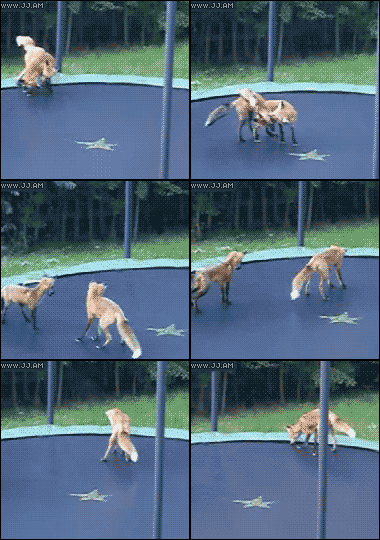
Best thing ever: a fox suddenly realising he’s standing on a trampoline

Ontario-based ceramicist Steve Irvine caught this long exposure shot of moths swirling around a floodlight at night

Here’s how scientists were able to make squid camouflage cells ‘dance’ to “Insane in the Brain” [Rusten: Better background on the making of the video than the link I sent around.]

Timelapse video of man drawing the Manhattan skyline freehand