Saturday, September 22, 2012

Dew-Covered Insects (photos)

Thanks to Ed Yong for including a link to this wonderful set of photographs in his weekly "Missing Links" post at Not Exactly Rocket Science:

Macro Photographs of Dew-Covered Dragonflies and Other Insects by David Chambon

Here are just three images (reduced in size) to give you a taste of what you'll find on the site itself. And follow the links on the site to many more by Chambon and other photographers.


Thursday, September 20, 2012

The Birth of the New, The Rewiring of the Old

This is a nice update from Carl Zimmer at The Loom on a (now) 24-year-old experiment, explaining something "weird" that happened in one of the serial cultures 4 years ago: the appearance and then improvement of citrate-eating E. coli in one of the flasks. "World domination soon follows."

Carl Zimmer, "The Birth of the New, The Rewiring of the Old"

Top of the story:
The Birth of the New, The Rewiring of the Old
  In 1988, Richard Lenski, an evolutionary biologist now at Michigan State University, launched the longest running experiment on natural selection. It started with a single microbe–E. coli–which Lenski used to seed twelve genetically identical lines of bacteria. He placed each line in a separate flask, which he provisioned with a scant supply of glucose. The bacteria ate up the sugar in a few hours. The next day, he took a droplet of microbial broth from each flask and let it tumble into a new one, complete with a fresh supply of food. The bacteria boomed again, then starved again, and then were transferred again to a new home. Lenski and his colleagues have repeated this procedure every day for the past 24 years, rearing over 55,000 generations of bacteria.

I first reported on Lenski's experiment 12 years ago, and since then I've revisited it every few years. The bacteria have been evolving in all sorts of interesting ways, and Lenski has been able to reconstruct the history of that evolution in great detail, thanks to a frozen fossil record. Every 500 generations Lenski and his students sock away some bacteria from each flask ...


One way to skin a cat

Nice story from Ed Yong on gene interactions in coat patterning. Beautiful photo, a good explanation of coat pattern genetics and protein diffusions, and even a Java applet of Turing reaction-diffusions to play with. In the story, Ed links to a previous story of his (which I think I sent) on pattern mixing in fish that included this classic image:

But back to today's story:

Ed Yong, "One way to skin a cat – same genes behind blotches of tabbies and king cheetahs"

Top of the story:
The cheetah's spots look like the work of a skilled artist, who has delicately dabbed dots of ink upon the animal's coat. By contrast, the king cheetah – a rare breed from southern Africa – looks like the same artist had a bad day and knocked the whole ink pot over. With thick stripes running down its back, and disorderly blotches over the rest of its body, the king cheetah looks so unusual that it was originally considered a separate species. Its true nature as a mutant breed was finally confirmed in 1981 when two captive spotted females each gave birth to a king.

Two teams of scientists, led by Greg Barsh from the HudsonAlpha Institute for Biotechnology and Stephen O'Brien from the Frederick National Laboratory for Cancer Research have discovered the gene behind the king cheetah's ink-stains. And it's the same gene that turns a mackerel-striped tabby cat into a blotched "classic" one.

Back in 2010, Eduardo Eizirik, one of O'Brien's team, found a small region of DNA that seemed to control the different markings in mackerel and blotched tabbies. But, we only have a rough draft ...

A couple of images ...

... and brief explanations from a Facebook page I follow: I f**king love Science. I've followed each image with a link to a site with more images and more explanation.

For the inhabitants of Singapore this bizarre yet spectacular sight took a while to get used to. Architects have designed 18 synthetic 'supertrees' which, for the last few months have been acting as thermal storage systems and providing sha
de and nutrients - just like natural trees. Their shape allows them to collect rainwater and they're equipped with solar panels to store energy from the sun. A sophisticated system of channels, similar to the roots of a tree, ensures that all 200 plant species cultivated inside the supertrees are regularly watered.


[Rusten: Here's a CNN story with a nice photo gallery of the park: "Solar-powered 'supertrees' breathe life into Singapore's urban oasis"]
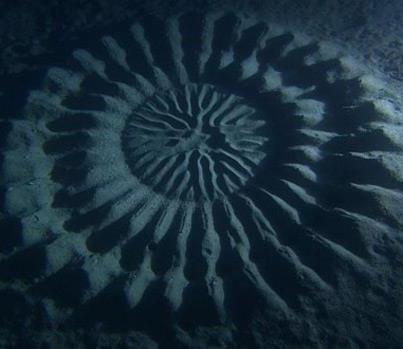
When underwater photographer Yoji Ookata discovered these bizarre geometric sand circles off the coast of Japan, he was understandably pretty confused. 
After returning to the site with colleagues and a television crew, they worked out that they're being made by male puffer fish. It's thought to be a 'display' to attract females and/or a shield to neutralize ocean currents that could pose a threat to their young.


[Rusten: Here's a site with a bit more detail: "The Deep Sea Mytery Circle - a love story"]

The Sweetness of Human Evolution

"The Sweetness of Human Evolution" is a lovely piece by Heather Pringle at The Last Word on Nothing on the honey-passionate Hadza in Tanzania ... though I want to know more about the interactions of the Hadza, the honeyguide bird, and the honey badger. So, below the "Top of the Story" bit, I've put a couple of links to YouTube videos that show some of the interactions.

Top of the story:
Quite by accident last week, I came across something, an ethnographic detail really, that captured my imagination, and that has clearly delighted and puzzled anthropologists and even contributed to a new theory of human evolution. The detail concerned the Hadza, 1000 or so modern hunter-gatherers who speak an ancient click language and who live in the woodlands around Lake Eyasi, Tanzania, not far from Olduvai Gorge.

The Hadza, as I discovered, prize honey above all else in their diet. Hadza mothers wean their young on liquid honey, and during the wet season, particularly the months of February and April, Hadza families gorge for weeks on its sticky sweetness.  The men possess an expert knowledge of bees and bee behavior, giving the honeys produced by different species different names. Those who forage for honey figure prominently in Hadza mythology.

And there is indeed something almost magical about the way that Hadza collect honey.

While out hunting, the men listen for the call of a small, robin-size bird known as the greater honeyguide (Indicator indicator). The bird dines almost entirely on beeswax and bee larvae, but it needs help to crack open hives. So the honey guide calls to both honey badgers and Hadza hunters ...

[Rusten: as promised, some video links to follow up on that last suggestion of interaction.]

Attenborough did a bit on the human-honeyguide interaction in Kenya:

BBC Talking to Strangers: honey birds

www.youtube.com
Believe it or not, also called honeyguides, these birds communicate with humans....

And here's a bit bringing in the honey badger:


Tuesday, September 18, 2012

Will we ever… photosynthesise like plants?

An excellent piece by Ed Yong on just how complex photosynthetic symbiosis is: Will we ever… photosynthesise like plants?


Top of the story:

Will we ever… photosynthesise like plants?
 HULK GREEN BUT NO CAN FIX OWN CARBON. THAT MAKE HULK ANGRY!

Here's the tenth piece from my BBC column

Humans have to grow, hunt, and gather food, but many living things aren't so constrained. Plants, algae and many species of bacteria can make their own sustenance through the process of photosynthesis. They harness sunlight to drive the chemical reactions in their bodies that produce sugars. Could humans ever do something similar? Could our bodies ever be altered to feed off the Sun's energy in the same way as a plant?

As a rule, animals cannot photosynthesise, but all rules have exceptions. The latest potential deviant is the pea aphid, a foe to farmers and a friend to geneticists. Last month, Alain Robichon at the Sophia Agrobiotech Institute in France reported that the aphids use pigments called carotenoids to harvest the sun's energy and make ATP, a molecule that acts as a store of chemical energy. The aphids are among the very few animals that can make these pigments for themselves, using genes that they stole from fungi. Green aphids (with lots of carotenoids) produced more ATP ...

Saturday, September 15, 2012

Favorites from Ed Yong's Picks (15 Sept 2012)

Fewer meaty stories this week caught my attention among Ed's picks. Some good photos and shorter pieces, though. I especially love the Google Earth fractals.


Ed Yong at Not Exactly Rocket Science

Stories, Mostly Short This Week

On the trail of a weird and wonderful mammal, the Pyrenean desman
Eagle regains ability to preen & drink w/ 3D-printed prosthesis. [Rusten: The sequelae to the prosthesis are interesting. Not a simple story.]
Awesomeness: How to boil water without bubbles
This Ewen Callaway piece on the genetics of tasting coriander features anti-coriander haikus and a recipe.
Deaf Mexican police officers tasked w/ monitoring security cameras; not recruiting disabled ppl, but “super-able”. Great Vaughan Bell piece.
Tiger tiger burning bright, avoiding humans in the night. Very cool study, covered by Bora Zivkovic.
This is a really sensible way of looking at whether electronics on flights are dangerous. Kudos to Dan Simons and Chris Chabris

Some photos (with and without text)

Winners of the 2012 British Wildlife Photography Award. Those GANNETS!
Mmmm… natural fractals as seen through Google Earth [Rusten: Go to the Google Earth Fractals site for more.]
 Jumping spider turns assassin bug into assassinated bug